Showing posts with label whole grains. Show all posts

Wednesday, March 1, 2017

Black Lentils with Black Rice & Black Shiitake Mushrooms


Four exceptionally nutritious ingredients form the core of this simple but delicious meal, perfect for warming up the last chilly days of winter. According to the principles of Traditional Chinese Medicine, these four foods have the ability to strengthen the "yang" energy of the body, which is created and nurtured in the area called the "Life Gate Fire", or  Ming Men Huo. 

Assembly is easy; simply measure the ingredients into a pot and cook for about one hour.  It's best to use a heavy pot with a thick bottom and tightly fitting cover. A simple kitchen tool called a flame tamer or heat diffuser is useful for cooking legumes and grains; it helps heat to penetrate evenly without scorching the bottom of the pot.  Slow, gentle cooking allows the grains and lentils to steam thoroughly and encourages the aromatic flavors to mingle.

 Yield: Roughly five servings.

Ingredients:

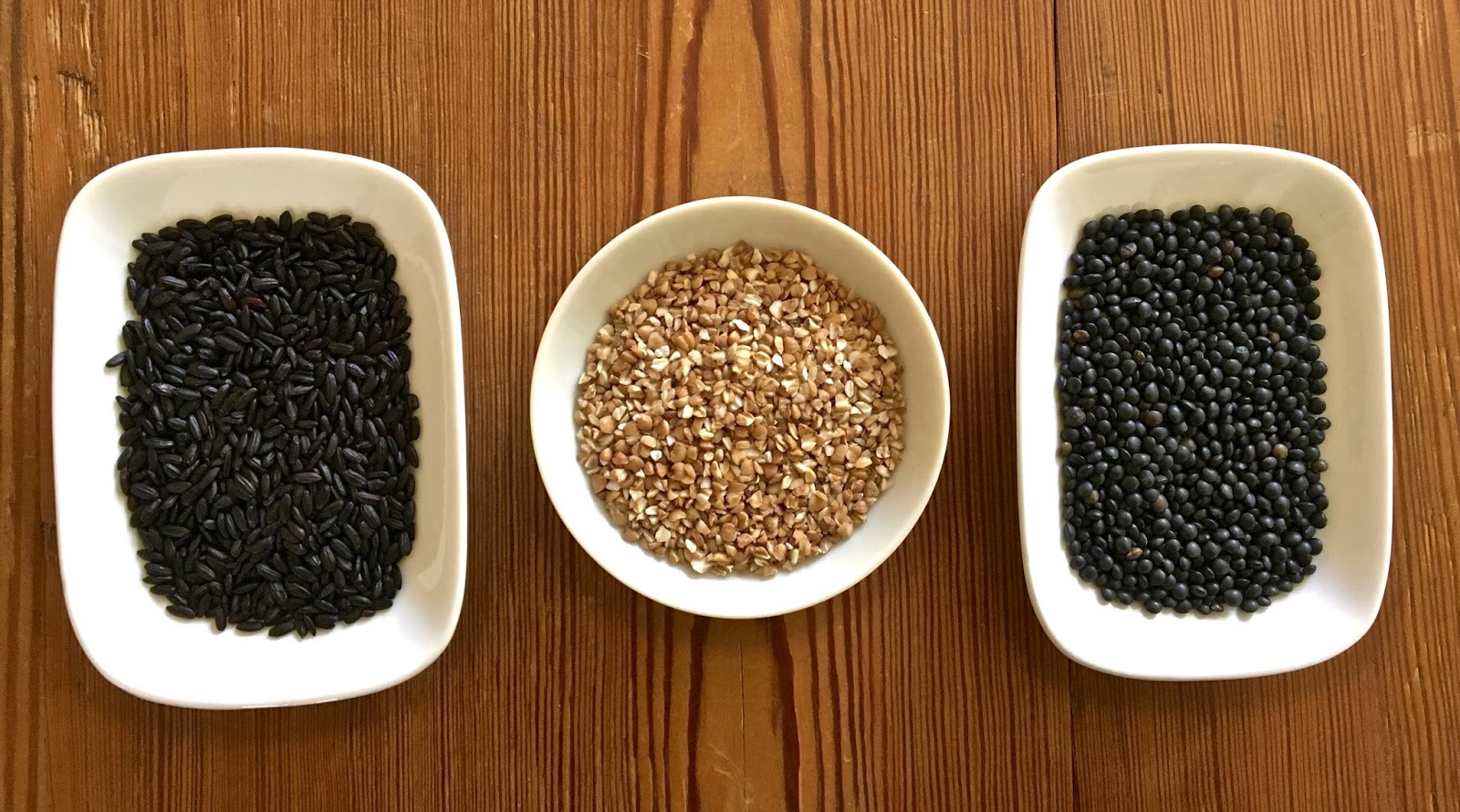
1 cup black beluga lentils
1 cup black "forbidden" rice
1/2 cup kasha (buckwheat groats)
2 whole garlic cloves, unpeeled
1 bay leaf
5 cups fresh water
1/4 + teaspoon  sea salt
6 whole dried black shiitake mushrooms


Method:

Measure lentils, rice, kasha, water and sea salt into the pot; add garlic and bay leaf.
Carefully place mushrooms, stem down, in one layer on top of the other ingredients.
Cover pot and bring to a gentle simmer. Place a flame diffuser under the pot to prevent scorching.
Continue cooking on a low to medium flame for about one hour.  
Remove pot from heat and allow to rest without opening for fifteen or twenty minutes.
Open pot and remove mushrooms, garlic cloves and bay leaf.
Place mushrooms on a cutting board and slice into small pieces.
Peel garlic- it will be very soft- and return it and the mushrooms to the pot.
Toss all ingredients with a fork; add more sea salt to your taste if desired.
Serve with any lightly steamed dark leafy green.


Tuesday, August 13, 2013

Late Summer: The Fifth Season


Late Summer is the fifth season of the traditional Chinese calendar, a brief interlude between Summer and Autumn. With the arrival of the fifth season, the fiery intensity of Summer heat, light and energy is in decline.  Late Summer is the transitional time between the season of rapid growth and the end of growth.


According to the philosophical theory of Wu Xing (the five transformational energies),  Late Summer is the season of Earth, which receives, holds and transmits the moisture, warmth and nutrients necessary for the final ripening of fruits, grains and other crops. It is a time of stillness and calm, a moment to savor the Earth's abundance, to gather energy for the harvest and to contemplate one's plans for the cooler darker days ahead.


"EARTH"

Wednesday, January 9, 2013

Japanese Sweet Potato Rice: Imo Gohan


Every year in the heart of winter, a few weeks after the New Year when the mornings are still very dark and the days are chilly, a small thought begins to ring persistently in my head like a distant bell. Eventually I realize that it is the bell of imo gohan, announcing that it's time to make a pot of this rustic Japanese sweet potato and rice dish, one of my winter favorites.

Japanese sweet potato, like the American sweet potato, does not look like much on the outside. It has a dull pinkish purple skin. When cooked, it is creamy yellow inside, pleasantly but not cloyingly sweet, and tastes something like a chestnut. This is the sweet potato for those who've never cared for the ultra sweet American variety.

Imo gohan  is a one pot meal, very simple to make. It's best to plump the brown rice first by soaking it over night or for about six hours, which will shorten the cooking time.  Rice, water and sweet potato then go into the pot together and are cooked for about one hour.  The addition of black or "forbidden" rice is optional, but it does add pleasing texture and color to the dish.

Imo Gohan:

2 cups short grain brown rice, soaked overnight, rinsed and drained
1 handful black rice (optional)
4 cups fresh water
2 medium Japanese sweet potatoes, scrubbed and cut into chunks
1 teaspoon sea salt
toasted sesame seed garnish (gomasio) or tamari sauce


Place rice in a heavy pot with water and sea salt. Arrange sweet potato pieces on top of the rice. It's ok if the potatoes are not entirely covered in water.


Cover and bring to a boil, then simmer on a low light for at least one hour. Place a flame tamer under the pot to prevent scorching. When rice is tender, turn off heat, fluff gently without mashing the sweet potatoes and allow to rest for 10 minutes before serving.


Imo gohan  is delicious sprinkled with gomasio or a little tamari sauce to taste. Serve in a pre-heated bowl. It is best enjoyed while studying the poems of Basho or contemplating the coming of spring and the Lunar New Year.

For more about Japanese Sweet Potato see post titled "Japanese Sweet Potato/ Satsuma Imo".
For gomasio recipe see post titled "Gomasio/ Sesame Seed Condiment".

Thursday, October 25, 2012

Kasha: Ancestral Super Food


A slender rectangular box of "Wolff's Kasha" was one of the more elegant packages in the kitchen cupboard of my youth, and the one which was never allowed to run out.  Kasha was a beloved staple in our household but few non-ethnic Americans were familiar with it then. Today, kasha is enjoying a moment of popularity among the health conscious and has been elevated to "super food" status.  My Eastern European ancestors did not know about super foods per se, but kasha was a mainstay in their diet and it sustained them through cold northern winters for many generations.

The buckwheat plant has been cultivated for over 4000 years. It thrives in cool climates with short growing seasons, hence its ubiquity in northern regions of Europe and Asia.  Russia, China and Ukraine are top cultivators of buckwheat, producing thousands of tons of buckwheat seed annually which is eaten whole or transformed into flour, noodles and other products.

In spite of its name, buckwheat is not in the wheat family and it is not even a grain. Rather, it is derived from the seeds of a flowering plant. Buckwheat groats are the hulled seeds of the plant, which when toasted are called "kasha".  Buckwheat is high in protein, minerals, antioxidants and fiber. It contains no gluten, making it an ideal food for those who are sensitive to gluten containing grains. Buckwheat appears to assist in stabilizing blood sugar in people with type II diabetes, and also has cholesterol lowering properties.

One of the best characteristics of kasha (other than its uniquely delicious flavor) is that it requires only fifteen minutes to cook, and is very easy to make. All that's needed is a heavy pan with a lid and the ability to boil water! Kasha doubles in volume when cooked and keeps well in the fridge for several days, so consider making extra to have on hand for a quick meal.

Fifteen Minute Kasha:

1 cup kasha
2 cups fresh water
1 pinch sea salt
a few drops of olive oil

Place water, salt and olive oil in pan and bring to a boil. Add the kasha, stirring briefly. When the kasha begins to boil, lower the flame, cover and simmer for fifteen minutes. Remove from heat, fluff with a fork, cover and allow to rest for five or ten minutes before serving.


Serving suggestions: Serve kasha as you would rice or any cooked grain, with steamed, stir fried or roasted vegetables. Add to a bowl of soup or legumes, or serve solo with a splash of tamari sauce. Heat leftover kasha with some nut milk or soy milk, add a little sweetener or dried fruit and serve for breakfast or any time of day for a warming, healthy and nutrient packed meal.

Note:  If you find only raw buckwheat groats in the market, it's easy to turn them into kasha by toasting them yourself.  Heat gently in a heavy iron skillet over a medium flame, stirring with a wooden spoon until fragrant and golden. Remove immediately from the pan and cool thoroughly before storing. 

If you are visiting Russia or Ukraine, note that the term "kasha" is used there to refer to any cooked cereal, not just buckwheat groats.


Monday, November 14, 2011

Healthy Eating on $4.50 a Day: Not a Snap!


A group of U.S. Congressional Representatives recently participated in "The Food Stamp (SNAP) Challenge" to draw attention to the plight of more than 45 million Americans currently receiving nutrition assistance. The representatives attempted to eat for seven days on a budget comparable to what the average recipient is allotted under SNAP, the Supplemental Nutrition Assistance Program in their respective states; in California that amount is $4.50 a day.

Inspired by their example but also disturbed by media reports of Congress persons subsisting on canned tuna, lettuce, white bread, pasta and hard boiled eggs, I decided to take up the challenge with the goal of eating a health supportive diet comprised almost entirely of high quality, unprocessed or minimally processed plant based foods.

Although it is not possible and was not my intention to replicate the circumstances of those who live month in and month out in truly challenging circumstances on a highly restrictive food budget, the experience was enlightening and humbling.

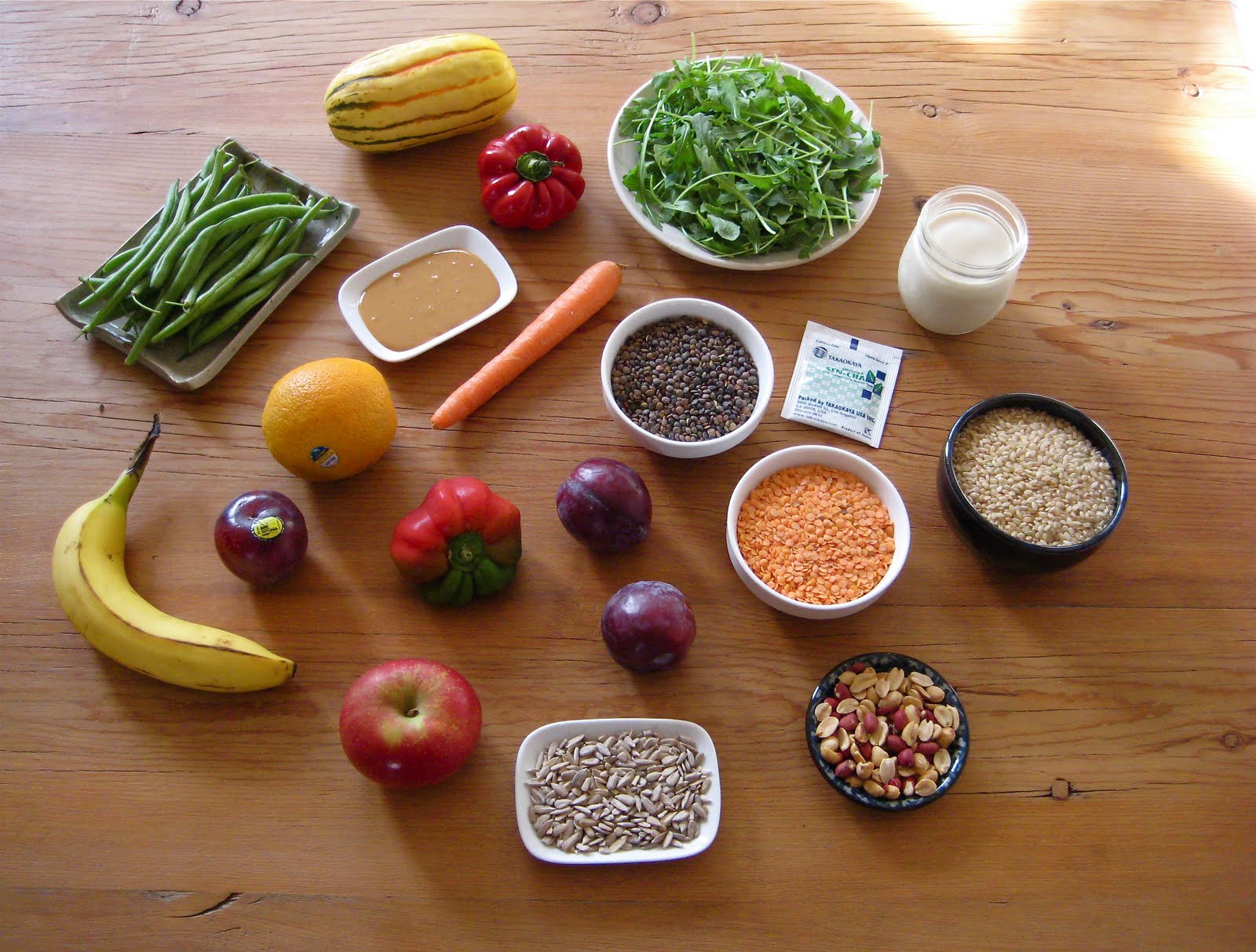
The photo above illustrates the typical selection of foods I ate during the seven day trial. By carefully planning, shopping and preparing all meals from scratch, it was possible to consume enough calories to maintain adequate physical energy, stave off hunger between meals and satisfy daily nutrition requirements.

However, it was a shock to discover how quickly I could exceed my daily budget simply by eating an extra piece of fruit, an added serving of peanut butter, soy milk or other snack. Lentils, brown rice and barley with vegetables provided satisfying and nutritious meals at a modest cost, but there was little or no room for unplanned grazing beyond the essentials.

It also became clear that the looming specter of food insecurity dramatically transforms one's relationship to eating. Even under the best of circumstances, the seven day challenge was far from a carefree experience and left me concerned about those for whom this is not an temporary experiment.

Basic food costs:

brown rice, 1 cup cooked $.37
barley, 1 cup cooked $.25
lentils, 1 cup cooked $.67
peanut butter, 2 TBSP $.21
peanuts, 2 TBSP $.24
sunflower seeds, 2 TBSP $.18
green tea bag $.16
plain soy milk, 1 cup $.50
banana, medium $.26
apple, medium $.55
orange, medium $.54
plum, small $.25
green beans, 1/4 lb $.50
carrot, medium $.29
winter squash, 1/2 $.59
arugula, 2 large handfuls $.42
sweet pepper, 1 small $.66


Note: Ingredients such as those used for preparing lentils included small amounts of leek, garlic, celery, olive oil, sea salt and dried herbs; these added little expense and therefore are not noted above.

Tuesday, November 1, 2011

Harvest Salad With Forbidden Rice


A refreshing and nutritious quick meal, Harvest Salad requires only two components- cooked Forbidden Rice (also known as black rice) and seasonal fresh vegetables. The sweet peppers which predominate in this recipe lend it vibrant flavor and color and contrast dramatically with the deep purple hued rice. Select three or four varieties of raw vegetables, cut them into roughly uniform pieces, and toss with rice. A sprinkling of fresh herbs adds a lively dimension to the salad; it's worth taking the time to track some down. If you don't have black rice, short grain brown rice works equally well.

Harvest Salad with Forbidden Rice

2 cups cooked black rice (room temperature)
2 - 3 sweet peppers of various colors, diced
1 carrot, diced
2 handfuls small arugula leaves
1 ripe tomato, diced
1 tablespoon fresh marjoram or oregano leaves
or a few torn basil or mint leaves
1 tablespoon olive oil
3 or more tablespoons rice vinegar, lemon juice or lime juice
sea salt to taste

Place rice in a bowl. Add vegetables and toss gently. Sprinkle with herbs, olive oil, vinegar and sea salt and toss again. Adjust seasoning and serve immediately. Salad may be assembled several hours ahead of time without the last three ingredients, which should be added just before serving.

Note: For instructions on cooking black rice, see post entitled "Forbidden Rice".

Wednesday, September 28, 2011

Onigiri: Honorable Rice Ball!


There is no more delicious and satisfying convenience food than the wonderful gem of Japanese cuisine, onigiri. For centuries, travelers have carried rice balls on short and long journeys, and today they are a beloved comfort food in Japan, where many specialty shops are devoted solely to the making and selling of onigiri.

Onigiri (also known as omusubi) can be very simple, consisting of nothing more than cooked rice, or they can be creative works of art which reflect the chef's imagination and skill. Rice balls always contain salt, tamari or pickled ingredients which act as preservatives, keeping the rice from spoiling. Pickled umeboshi plums are a favorite traditional filling.

Only short grain or medium grain rice should be used to make onigiri; long grain does not have the proper consistency. Although white rice is most popular, brown and black rice make flavorful, nutritious onigiri. Correctly cooked rice- not too soft or hard- is essential for the rice balls to retain their shape. Round, cylindrical and triangular shapes are made by hand but many varieties of inexpensive molds, one of which is seen in the photo above, are available with which anyone can make perfectly shaped rice balls.

Black rice makes stunningly beautiful onigiri. Unwrap one of these on an airplane and your seatmates will be terribly envious. Pack a handful of sliced raw vegetables and enjoy a healthy, inexpensive meal with roots in an ancient tradition. You will understand with the first bite why the honorific "O" is included in the spelling of onigiri, which means "honorable rice ball".

Wednesday, September 14, 2011

Forbidden Rice


In ancient days in China, according to legend, black rice was reserved exclusively for the Emperor and his court; commoners were forbidden to eat it. Black rice was prized for its exotic purple- black color, nutty sweet flavor and especially for its potent medicinal qualities.

The distinctive color of black rice is caused by the presence of high levels of anthocyanins, a class of antioxidants which are also found in many plant foods including blueberries, blackberries, raspberries, strawberries and purple cabbage. Research into antioxidant nutrients suggests that they contain valuable health protective properties. Black rice is also an excellent source of protein, vitamins and minerals, including iron, and has even more fiber than brown rice.

One of the advantages of black rice is the small size of the grains which cook more quickly than other rice varieties. Exact cooking time may vary a bit but black rice requires only about 30 minutes to cook thoroughly. If you prefer softer, less chewy rice, soak for a few hours before cooking.


Basic Black Rice:

1 cup black rice
1+3/4 cups water
1 pinch sea salt
1/4 teaspoon olive oil

Place ingredients in a pot with a thick bottom and close fitting lid. Bring to a simmer, cover, and cook over a low flame for about 30 minutes. (A flame tamer placed under the rice will prevent scorching). Fluff rice with fork or chopsticks, turn off heat, cover and allow to rest for at least 10 minutes before serving. Yield: About 3 cups cooked rice.

Thursday, August 11, 2011

Cooking with Pressure: Fast, Healthy, Flavorful


Most younger Americans have probably never seen a pressure cooker, let alone used one. Pressure cookers had their heyday in the 1940's following their introduction at the 1939 New York World's Fair, but they were soon supplanted by the huge wave of convenience foods which swept the country in the 1950's, when most of those old cookers were relegated to basements and attics and forgotten.

But pressure cookers retained a place of honor in kitchens throughout much of Europe, South America, North Africa and India, where they are valued for making flavorful healthy meals which are also remarkably fuel and time efficient. The most beautifully designed sleek, safe and durable pressure cookers like the Italian one in the photo are made by European manufacturers; these contemporary stainless steel models last for a lifetime and are a pleasure to use.

Today the pressure cooker is again gaining recognition in the U.S. among cooks who appreciate the intense, concentrated and pure flavors created by relatively brief cooking under pressure. Dense vegetables like beets, winter squash, carrots and potatoes cook in roughly one third the time required by conventional cooking methods, as do legumes, brown rice, barley and other whole grains. Savory vegetable stews, soups and sauces which normally require slow cooking can be prepared in minutes using a single pot from start to finish.

I acquired my first Italian pressure cooker in 1982 and have used it year round since then. In warm weather I prepare garbanzo beans or white beans to use in fresh green salads with ripe tomatoes and herbs. In autumn when apples and pears are plentiful, I make apple- pear sauce with cinnamon and ginger; in winter, black beans and spicy red bean chile are often on the menu. Winter and summer, this dependable kitchen tool keeps the pressure in the pot where it belongs, and out of the kitchen.


Tuesday, May 24, 2011

Muesli for Dinner (or lunch or breakfast)


Muesli for dinner? It might not be what Herr Doktor Professor Maximilian Oskar Bircher-Benner had in mind back in the late 19th century, but at the end a busy 21st century day, muesli can be a quick healthy solution to the evening meal challenge.

Legend has it that Bircher-Benner was served muesli while traveling in the Swiss Alps and was so impressed with the vitality of the animal herders who consumed it regularly that he was inspired to bring the concept back to his Zurich patients in hopes of improving their health. It became a classic breakfast cereal still known in Europe as Birchermuesli.

Unlike granola (which also dates back to the late 19th century) the grains in muesli are not toasted or roasted, and no oils or sweeteners are added. Rolled oats are the most commonly mentioned grain in muesli recipes; rolled rye and wheat flakes are also used. Nuts, seeds, dried and fresh fruit complete the mix.

My simple version of homemade muesli really requires no recipe; I just toss whatever ingredients I find in my pantry into a bowl, add some fresh fruit, soy milk or nut milk, and eat. Here's what was in my bowl last night! (Makes one serving).

Monday Night Muesli

1 pink lady apple, chopped
1 heaping tablespoon organic rolled oats
1 tablespoon almonds, chopped
1 tablespoon hazelnuts, chopped
1 tablespoon sunflower seeds
1 tablespoon golden raisins
1 medjul date, chopped
a few drops vanilla extract
soy milk (or nut milk)

Put it all in a bowl, adding as much soy milk as you like. Eat very slowly while visualizing craggy mountain peaks and blue skies, meadows carpeted with wildflowers and little snow white goats grazing in the sunlight.

Wednesday, March 2, 2011

Real Oatmeal with Medjool Dates & Toasted Almonds


A recent column by Mark Bittman of the New York Times critiquing McDonald's new offering of "Fruit and Maple Oatmeal" generated hundreds of fascinating online comments from readers. ("How to Make Oatmeal...Wrong"). I was inspired to pick up some organic rolled oats from my natural food store and get to work refining my favorite oatmeal recipe, just in time for the Bay Area's last blast of windy wet winter weather.

Oatmeal is quick, easy, cheap, nutritious and satisfying; anyone from the age of eight up can make a great bowl of oatmeal in five minutes flat with some plain bulk rolled oats as seen in the photo above- no special quick or instant versions necessary- and a few added ingredients. Here's how. Makes one serving.


Real Oatmeal with Medjool Dates & Toasted Almonds

1/2 cup organic rolled oats
1 cup plain soy milk
1/2 cup fresh water
1 pinch sea salt
1 tablespoon golden raisins
2- 3 Medjool dates, pitted and chopped
1 teaspoon nut butter (almond, peanut or other)
1 teaspoon maple syrup (optional)
toasted chopped almonds

Put oats, soy milk, water and sea salt in a small pan; cover and bring to a simmer. Add raisins and dates, cover and cook gently on low heat for about 5 minutes. If you prefer creamier oatmeal, stir well and cook for a few more minutes. If oatmeal is too thick, add a bit more water or soy milk; if too thin, remove lid and continue cooking until the cereal thickens. Stir in nut butter and maple syrup if using, and serve immediately in a warm bowl. Garnish with toasted almonds.

Note: "How to Make Oatmeal...Wrong" by Mark Bittman can be found below right by clicking on my twitter feed; look for February 22 tweet.

Tuesday, January 4, 2011

White Bean & Barley Cholent: A Winter Cassoulet


During a recent chilly, rainy week I had a sudden yen for a bowl of cholent, the traditional slow simmered dish beloved by generations of European Jews and their descendants in the diaspora. Cholent typically contains a combination of beans, barley, potatoes and meat seasoned with onions and garlic; it is cooked overnight in a heavy covered dish and eaten as the main meal on Shabbat, the day of rest. Jews of Middle Eastern heritage prepare a similar recipe called hamin (Hebrew for "hot"); the equivalent North African dish is known as deffina.

Both cholent and hamin closely resemble the rustic French slow cooked cassoulet; in fact some sources claim that cholent was the predecessor of cassoulet and that etymologically, cholent is derived from the French words chaud (hot) and lent (slow). Much lively discussion can be had about the origins of cholent, its preparation and which ingredients are truly authentic, but what really matters is the final result: a satisfying, warming meal to be savored slowly in the cold days of winter.

This vegan rendition of cholent/ cassoulet is simple to assemble; it may be cooked on the stove top or in the oven. You may also begin the cooking process on the stove and continue it in the oven. Use a heavy pot with a thick bottom and a tight lid. The beans and barley need about an hour to cook thoroughly but the flavor will deepen with longer cooking. The ratio of beans to barley is flexible and may be altered to your taste. To slow bake in the traditional manner, set oven at 225 degrees and cook for at least three hours or overnight.


2 tablespoons olive oil
2/3 cup leek or onion, chopped
1 rib celery, chopped
2 cloves garlic, chopped
2 bay leaves
1+1/2 cups white beans, soaked 6- 8 hours
1 cup pearl barley
6 cups or more fresh water
1 large carrot, sliced into rounds
2 or 3 small Yukon Gold potatoes, quartered
1 teaspoon dried sage leaves
1/2 teaspoon sea salt (or to taste)
1- 2 teaspoons good quality paprika

In a heavy soup pot saute leek, celery and garlic in olive oil until fragrant. Add bay leaves, beans, barley and water. There should be at least one inch of water covering the beans and barley; most of the liquid will be absorbed during cooking. Bring to a boil and lower heat to a simmer. Place a flame tamer beneath the pot to ensure even heat and to prevent scorching. Allow to cook for at least 45 minutes or until beans and barley are tender, adding more water as needed. Layer carrot slices and potatoes on top of beans and barley, sprinkle with sage leaves, sea salt and paprika. Cover pot and allow to cook another 20 or 25 minutes or until vegetables are tender.

The finished dish will be very thick; serve in warm bowls garnished with a little chopped parsley or other green. Store cholent/cassoulet in glass containers in fridge for several days. For a quick meal heat thoroughly, adding water as needed to create a bowl of bean & barley stew as seen in the photo above.

Sunday, November 2, 2008

Rainy Day Lentil & Barley Soup

When the first rains begin to fall in San Francisco each autumn, it's a signal for me to spend a few hours in my kitchen preparing a big pot of homemade soup. This lentil & barley recipe will fill your kitchen with a delicious aroma and keeps well in the fridge for quick re-heating all week long. If you've planned ahead and can pre-soak the barley for even a few hours, the cooking time will be shorter. But this recipe is so easy to assemble that a little more time for cooking will hardly be noticed.


2 tablespoons olive oil
1 cup leek, sliced
1 large carrot, diced
2 ribs celery, sliced
2 large garlic cloves, diced
1 handful parsley leaves, chopped
1 large bay leaf
1 cup French lentils
2/3 cup barley
6 cups fresh water (plus extra as needed)
1 14 ounce can organic tomatoes, whole or crushed
1/4 teaspoon dried red chile flakes
1 teaspoon dried oregano or marjoram
1 tablespoon white miso paste
3 or more cups fresh leafy greens, chopped (spinach, chard, arugula)

Heat olive oil in a heavy soup pot and saute leek, carrot, celery, garlic and parsley until golden and fragrant. Add remaining ingredients (except miso and greens) and bring to a simmer. Place a flame tamer under pot, cover, and cook on medium heat for at least an hour or until barley is completely tender. ( If necessary, add a bit more water if soup is too thick). In a small bowl, dissolve miso paste in a few tablespoons of soup and return to pot. Taste soup and correct seasoning. Just before serving, add greens to pot and heat until wilted, about five minutes. Serve soup in warm bowls. Garnish with a little fresh lemon juice, tamari soy sauce, or Louisiana hot sauce.

Note: As I was working on this recipe, an old English- American nursery song came to mind, a reminder of a long ago time when people composed and sang songs about farming:

"Oats peas beans and barley grow, oats peas beans and barley grow, Can you or I or anyone know, how oats peas beans and barley grow...?"

Wednesday, September 17, 2008

Vegetable Barley-Rice Soup

This simple vegetable barley-rice soup is reminiscent of the very substantial and deliciously complex mushroom barley soups which were a staple in the kitchens of my mother and grandmother; brown rice and miso paste were unknown to them but their soups were thickened with lots of potato and barley and flavored by the smokey foresty flavors of imported dried Russian mushrooms. This recipe is simply a combination of vegetable miso soup and cooked barley-rice (mugimeshi). The vegetable soup requires only minutes to prepare; then add as much mugimeshi as desired. Of course, any other cooked grain which you happen to have on hand may be used in the same way. (See previous posts for miso soup and barley-rice recipes).

2-1/2 cups fresh water
1/2 carrot, diced
1/2 celery rib, diced
1 tablespoon leek, sliced
1/2 zucchini, sliced
1 cup cooked mugimeshi (barley-rice)
2 teaspoons white miso paste

Combine water and vegetables in a small soup pot. Cover and bring to a gentle simmer; cook on a low flame until vegetables are tender. (About 5 minutes). Add mugimeshi and simmer another 2 or 3 minutes. Dissolve miso paste in a small bowl with some soup broth, add to pot, and warm for another minute without boiling. Serve in a pre-heated bowl. Optional: Garnish with a few drops of lemon juice or umeboshi vinegar.
Yield: One serving.

Monday, August 25, 2008

Barley Rice/ Mugimeshi

One of my favorite brown rice recipes is "mugimeshi", a traditional Japanese dish made by steaming barley and brown rice together in one pot. If you appreciate the satisfying flavor and texture of whole unprocessed grains, you will return to mugimeshi again and again. Use the same cooking technique as for brown rice; steam two parts water to one part grain. (For nutrition information, see "Brown Rice Basics" post.)

1 cup short grain brown rice
1/2 cup barley
3 cups fresh water
1/4 teaspoon sea salt
1/4 teaspoon olive oil

Place all ingredients in a heavy bottomed pot with a tight fitting lid. Cover and bring to a gentle simmer, place flame tamer under pot, and continue cooking on a low flame for one hour. Grain should be tender but not mushy. Turn off heat and allow mugimeshi to rest for about 10 minutes before serving.

Serve with vegetables as you would other cooked whole grains. Or, for a traditional and elegantly simple presentation, serve in small bowls topped with nori slices and toasted ground sesame seeds. (A recipe for making your own toasted and ground sesame seeds called "gomasio" will follow).

Friday, August 8, 2008

Brown Rice Basics

There are many techniques for cooking brown rice but this is the one to which I always seem to return. It requires only a heavy bottomed pot with a cover which fits well enough to hold in the steam as the rice cooks. If you own a flame tamer to place under the pot, that will keep the rice from sticking or burning if you happen to wander away from the kitchen. I usually use short grain organic brown rice, but long grain can be used also, or a combination of both.

1-1/2 cups organic brown rice
3 cups fresh water
1/4 teaspoon sea salt
1/4 teaspoon olive oil

Place ingredients in pot and cover. Bring to a gentle simmer, place flame tamer under pot, lower heat, and cook for one hour without opening the pot. Turn off heat and allow rice to rest for ten minutes. Makes about 2 servings. Cooked rice keeps well for several days in the fridge in a covered container.

Note: If you can plan ahead, pre-soaking the rice for about six hours or overnight will reduce cooking time and produce a delicious result. Just place rice and water in pot and let sit in a cool place. Before cooking add salt and olive oil; then cook as directed for about 50 minutes.

Tuesday, July 29, 2008

The Tao of Rice

When the Dow is down, the price of petroleum and almost everything else is up, and life in general looks a little rocky, I don't call my broker, my therapist, or my spiritual adviser. I pull out a bag of organic brown rice, my ancient stainless steel rice pot, and get cooking. The ultimate "slow food", brown rice cannot be prepared or eaten in a hurry. An hour spent in the kitchen making a fragrant batch of this simple grain is a perfect antidote to the up and down cycles of life in the turbulent 2000's.

Although anthropologists do not agree on exactly when humans began rice cultivation, there is good evidence that large scale rice farming dates at least as far back as 5000 BCE. Before the era of domestication, people gathered wild rice. Today rice provides one fifth of all the calories consumed by the earth's human inhabitants.

Most rice eating cultures place a high value on "white" or milled rice. Milling removes the outer layer of bran, leaving a light colored, faster cooking grain, an important consideration in countries where cooking fuel is a serious budgetary factor. However, the rice bran contains important B vitamins, minerals, and essential oils, all of which are lost in the milling process.

Japanese prison inmates today are routinely fed brown rice and barley, which are cheaper than white rice and viewed as low- status foods by the general population. A study done on inmates at the Fukushima prison found that prisoners with type two diabetes experienced a dramatic improvement in their blood sugar levels during their time as inmates and were able to reduce or discontinue their diabetes medications. This outcome was attributed in part to the high level of dietary fiber and nutrients in brown rice and barley.

Brown rice first gained popularity in America in the 1970's, when a wave of heightened consciousness about healthy food spread across urban and university culture, where it became emblematic of a new approach to eating and marked a significant departure from the t.v. dinners and meat and potato diet typical of the post war Eisenhower era. Now widely available in natural food stores, brown rice has become main stream enough to be featured in recipes published recently in The New York Times.

Although learning the tao of rice takes a little time and patience, its rewards are many. No matter where the Dow is, a simple brown rice meal always tastes great, costs pennies, and provides quality nutrition and shelter from any storm.

(Coming soon: Basic Brown Rice Recipe)

Monday, June 30, 2008

Almost Instant Hot Millet Breakfast Cereal

Cooked grains such as millet and rice can be transformed into a delicious hot breakfast cereal in less than five minutes. Place equal amounts cooked grain and fresh water into the blender and process until fairly smooth, adding a little more water if needed to attain the consistency you prefer. Try using some plain soy milk for blending the cereal if you wish. Heat and serve as you would oatmeal or cream of rice. Add a little sea salt to taste, some cut up dates or raisins, toasted almonds or other favorite garnish. The flavor, freshness, and nutritional content of this simple meal surpasses that of any packaged breakfast product, and at a fraction of the cost.

Thursday, June 26, 2008

Simple Steamed Millet

Steamed millet and rice can be cooked using the same method. Use a pot with a thick bottom and tight fitting lid. It helps to have a "flame tamer" to place under the pot to distribute the heat evenly thus preventing the grain from sticking or burning.

1 cup millet
2 cups water
1 pinch sea salt
a few drops olive oil

Place all ingredients into pot, cover, and carefully bring to a boil. Reduce flame to low, place flame tamer under the pot and cook for about 30 minutes. Grain should be fluffy and tender. Turn off heat and allow to rest for 5 or 10 minutes before serving.

Serve millet with steamed or stir fried vegetables; add to vegetable stews or soups. Cooked millet will keep several days in the fridge in a covered container.

Wednesday, June 25, 2008

Millet: Not Just for the Birds

Although the cultivation of millet as an edible cereal grain has been traced as far back as 2000 BCE, it is familiar to westerners primarily as a component of commercial bird seed mixtures. (It's the little round yellow one). Millet, not rice, was a staple in prehistoric Asian societies. After the Vietnam war, it was rumored that the North Vietnamese soldiers, who had only millet to eat, had triumphed over the South Vietnamese troops because of millet's nutritional superiority over white rice. Millet, which technically is a seed and not a grain, is widely grown and eaten in Africa and India, and has a long history in Eastern Europe as well.

I like millet because of its beautiful yellow color when cooked, its nutty mild flavor, its versatility, and its relatively short cooking time. (About 30 minutes). Although the price of most rice varieties has doubled recently, millet remains very affordable at almost half the cost of rice. Natural food stores sell millet, which will keep for months in your pantry in a tightly closed jar. (I do always keep a little extra on hand in winter for my backyard birds).

A cup of cooked millet contains more than 6 grams of protein and is high in manganese, magnesium, phosphorus and tryptophan; it is also an excellent source of insoluble fiber. As a whole grain, millet provides many essential nutrients which are largely missing from the standard American diet, and which cannot be replicated by vitamin supplements. Since millet is not in the wheat family, it may be eaten safely by those who must avoid gluten.

Perhaps it's time to learn something from the birds and elevate millet from its humble place as a lowly but ancient source of valuable life sustaining food.

See next post for a simple millet recipe and several serving suggestions.